We used the tuning fork in class to be able to calculate the frequency. We hit the tuning fork on our shoe and then put it next to the microphone on the sound probe. The sound probe was used to get the frequency which was the highest bar on the graph. Then once we got frequency, we plugged the number into wolfram alpha to get the musical note for the tuning fork.
The Palm Pipe Lab got the musical note in a slightly different way. First, we measured the length/diameter of our palm pipe. Once we got the diameter and length, we plugged it into a formula to get the wavelength which is what we needed in order to get the frequency since we already had the speed of light, but not the wavelength. Once we finally plugged in the wavelength and got the frequency, we plugged in the frequency into wolfram alpha to get the musical note. We learned how to find the musical note of the pipe which helped us to play a song, but it didn't seem to go too well.
Sunday, May 5, 2013

Light and Optics Real World Connection

Sunday, April 21, 2013
Magnetism Lab
Question: How can we use the right Hand Rule #1 help us predict the direction of a magnetic field generated by electricity (current)? (Standard 6.2)
The right hand rule #1 can be used to help us predict the direction of a magnetic field generated by the current by realizing that the current can produce a magnetic field. Currents are moving charges that flow through loops which makes it magnetic. The right hand rule #1 works by pointing your thumb with the direction of the current and finger curls in the direction of the magnetic field. Depending on which direction your thumb goes will tell you which way the current is going. The direction that your finger curls will either tell you that the magnetic field is going into or out. Using the right hand rule #1 can be an efficient way to finding the direction of the magnetic field.
Sunday, February 10, 2013
Lemon Battery Lab: Real World Connection
Link: http://www.apple.com/batteries/
What materials is the iPad battery made with?
The iPad battery is made with lithium ion which is made from polymer.
How does the iPad battery function?
 The iPad battery functions by recharging. Most lithium-ion polymer batteries use a fast charge to charge the iPad to 80% battery capacity, then switches to something called "trickle charging." That’s
about two hours of charge time to power an iPad to 80% capacity, then
another two hours to fully charge it to 100%, but only if you are not using the iPad
while charging.
The iPad battery functions by recharging. Most lithium-ion polymer batteries use a fast charge to charge the iPad to 80% battery capacity, then switches to something called "trickle charging." That’s
about two hours of charge time to power an iPad to 80% capacity, then
another two hours to fully charge it to 100%, but only if you are not using the iPad
while charging.
What are some future plans for improving iPad batteries?
Some future plans for improving iPad batteries is that the ipad battery will not last longer, but will try to maximize the use during the hours with battery. Apple may try to minimize the battery consumption on movies, apps, or other things that burn battery faster.
Real World Connection:
The article that I found brings up some things similar to our class discussion. The article describes batteries which involves voltage which is something that we have been discussing in class. I learned about what kind of battery the iPad uses and what the function of it is. Batteries can be such powerful things because without them, many things would not be able work. Batteries can be used in many different forms such as a lemon which is what we did in class trying to use the lemon as a battery.
What materials is the iPad battery made with?
The iPad battery is made with lithium ion which is made from polymer.
How does the iPad battery function?
What are some future plans for improving iPad batteries?
Some future plans for improving iPad batteries is that the ipad battery will not last longer, but will try to maximize the use during the hours with battery. Apple may try to minimize the battery consumption on movies, apps, or other things that burn battery faster.
Real World Connection:
The article that I found brings up some things similar to our class discussion. The article describes batteries which involves voltage which is something that we have been discussing in class. I learned about what kind of battery the iPad uses and what the function of it is. Batteries can be such powerful things because without them, many things would not be able work. Batteries can be used in many different forms such as a lemon which is what we did in class trying to use the lemon as a battery.
Friday, January 25, 2013
Projectile Motion Reflection on Learning
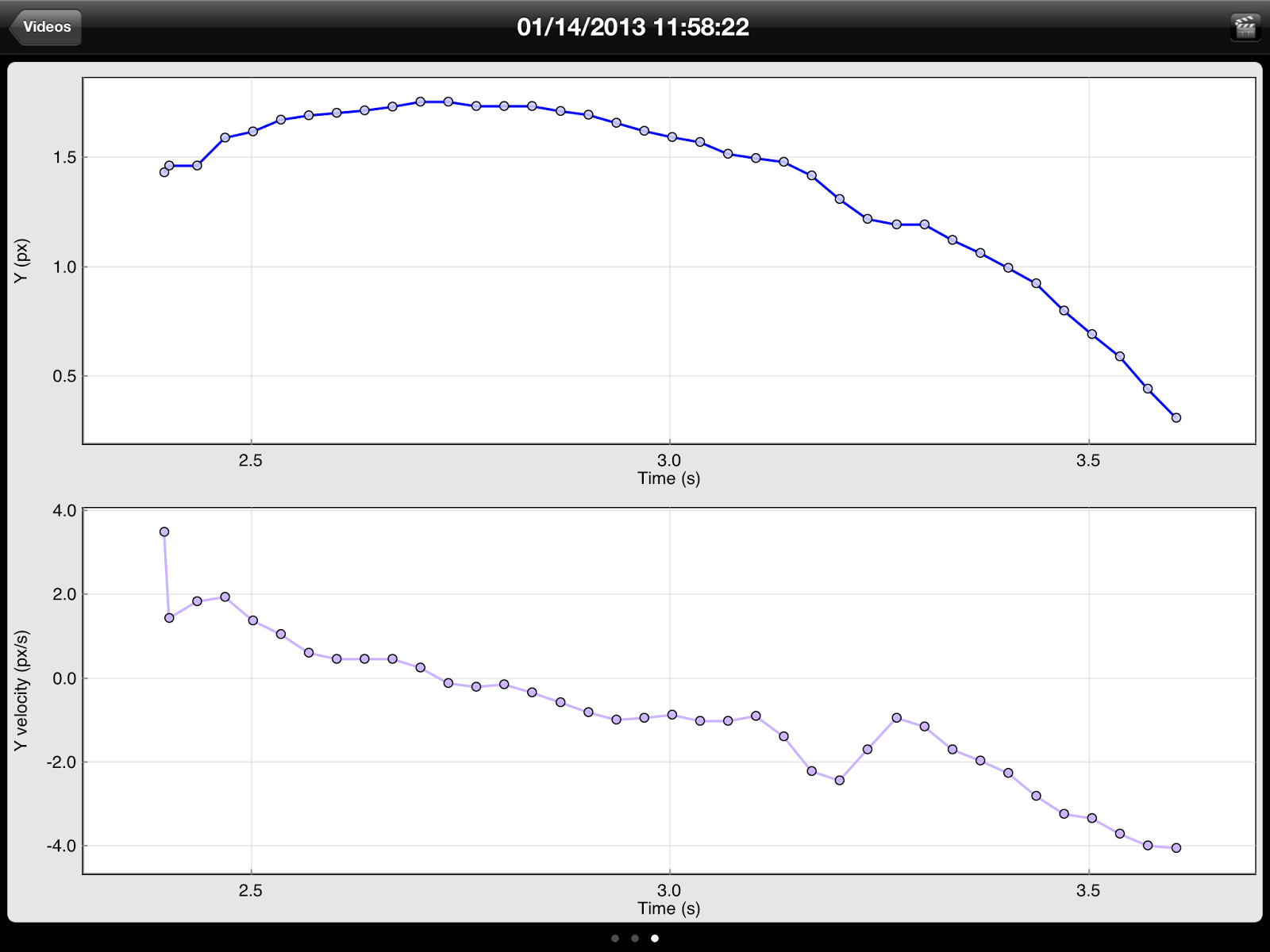
 The Projectile Motion Basketball Lab makes use of a projectile. A projectile is something that is in the air and nothing else except for the force of gravity is acting on it. One person shoots the basketball and another person uses their ipad to record them. We then use the Vernier Video Physics App to analyze the shot taken by the person. The information that we got from the video was the X and Y Graph. The X graph shows the horizontal movement of the basketball and the Y graph shows the vertical movement. The velocity of X is always constant, but Y can change. What I noticed from the lab was that the basketball was shot in a kind of arc.
Sunday, January 13, 2013
Forces in 2D and Circular Motion
Big Questions:
1) What does it mean to analyze forces in 2D?
2) How do forces cause objects to move in a circle?
3)What does it mean to be in orbit? How do satellites orbit planets? How do planets orbit the sun?
During class this week, we have been learning about forces in 2D and Circular Motion. We learned about tension and how to find the Fx and Fy by using SOH CAH TOA which is something that we learned last year in geometry. During the lab involving the hover disk, we had the hover disk connected to a string which we used to move in a circle. The reason that the hover disk moved in a circle was due to the tension that we applied on it. The part of the lab where we had to spin the hover disk in a circle and then release it was to see if it would continue moving in a circle. My group and I concluded that it went in a straight line and the reason it did not continue moving in a circle was because no tension was being applied after releasing the hover disk.
Being in orbit means that the object still moves in a circle and continues going around. Satellites orbit planets with the help from the gravitational pull which makes the object fall at high speeds but is still moving in a circle due to the planet orbiting around. Planets orbit the sun with the help of the sun's gravity which is similar to all other planets.
1) What does it mean to analyze forces in 2D?
2) How do forces cause objects to move in a circle?
3)What does it mean to be in orbit? How do satellites orbit planets? How do planets orbit the sun?
During class this week, we have been learning about forces in 2D and Circular Motion. We learned about tension and how to find the Fx and Fy by using SOH CAH TOA which is something that we learned last year in geometry. During the lab involving the hover disk, we had the hover disk connected to a string which we used to move in a circle. The reason that the hover disk moved in a circle was due to the tension that we applied on it. The part of the lab where we had to spin the hover disk in a circle and then release it was to see if it would continue moving in a circle. My group and I concluded that it went in a straight line and the reason it did not continue moving in a circle was because no tension was being applied after releasing the hover disk.
Being in orbit means that the object still moves in a circle and continues going around. Satellites orbit planets with the help from the gravitational pull which makes the object fall at high speeds but is still moving in a circle due to the planet orbiting around. Planets orbit the sun with the help of the sun's gravity which is similar to all other planets.
Sunday, November 18, 2012
Fan Cart Lab/ Hover Disc Lab
Purpose: The purpose of the Fan Cart lab is to be able to understand Newton's 3 Laws of Motion.
Big Questions: What is the RELATIONSHIP between MASS, FORCE and ACCELERATION?
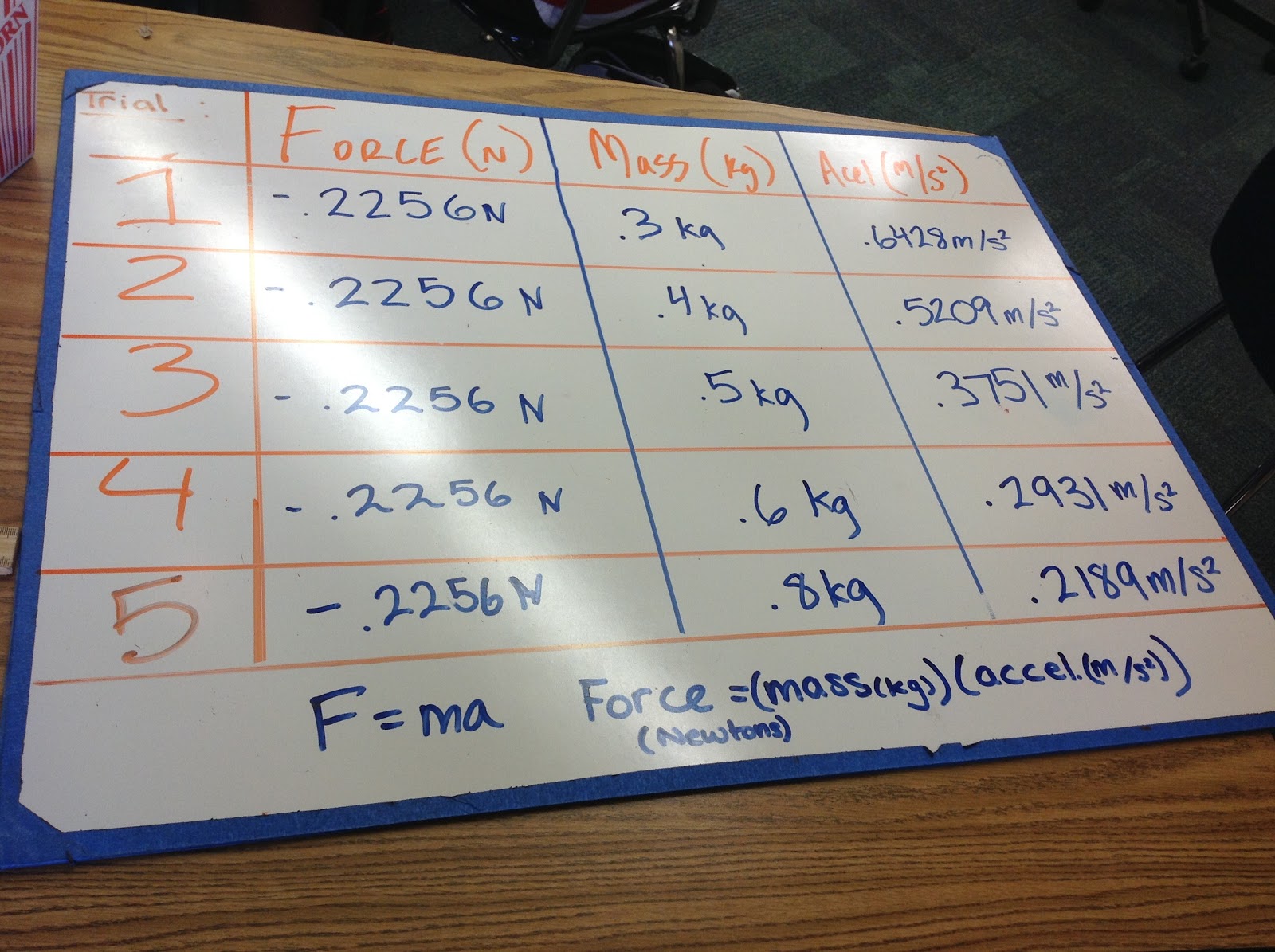
The relationship between mass, force, and acceleration is that they are all related because the mass and force can be factors that change the acceleration and since the more force applied may make the acceleration faster depending on the mass of the object.
What gives rise to a change in motion?
The different forces acting upon the hover disc while on top of the pocket of air changed the way the disc moved since there was no friction.
Data/ Whiteboard:
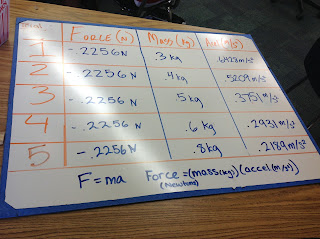 This whiteboard shows the data my group and I collected for the Fan Cart lab. We included the 5 trials and the force, mass, and acceleration. As you can see, the force is constant, but the mass is different for each trial which greatly changed the acceleration. The less the mass was, the more the acceleration.
Real Life Connection:
This lab connects to our everyday life because if you try to pull against something heavy it is still going to be the same force even though you may be pulling in an opposite direction. This picture shows a boy trying to pull the wall and an elephant, but what you can see is that the force is the same for both pictures, but the elephant is moving, but not the wall.

Big Questions: What is the RELATIONSHIP between MASS, FORCE and ACCELERATION?
The relationship between mass, force, and acceleration is that they are all related because the mass and force can be factors that change the acceleration and since the more force applied may make the acceleration faster depending on the mass of the object.
What gives rise to a change in motion?
The different forces acting upon the hover disc while on top of the pocket of air changed the way the disc moved since there was no friction.
Data/ Whiteboard:
Real Life Connection:
This lab connects to our everyday life because if you try to pull against something heavy it is still going to be the same force even though you may be pulling in an opposite direction. This picture shows a boy trying to pull the wall and an elephant, but what you can see is that the force is the same for both pictures, but the elephant is moving, but not the wall.
Sunday, October 28, 2012
Impulse Lab
Purpose: The purpose of the Impulse Lab was to use the red car to crash into the force- probe attached to the ring stand to record the velocity before and after the collision. After getting the velocities, we needed to record the area under the force vs. time graph to get our impulse which is the momentum after - momentum before.
Big Question: What is the relationship between impulse, force, and time during a collision?
The relationship between impulse, force, and time during a collision is that the amount of force can change depending on the time which can affect the momentum. The momentum before and after are needed to get the impulse.
Data/ Whiteboard


Big Question: What is the relationship between impulse, force, and time during a collision?
The relationship between impulse, force, and time during a collision is that the amount of force can change depending on the time which can affect the momentum. The momentum before and after are needed to get the impulse.
Data/ Whiteboard

This is a picture of another groups whiteboard which shows their velocity before and after for the collision. The area is also included. The equation Pafter-Pbefore was used to get the impulse for the lab.
Connection to Real Life:
The Impulse lab connects to our real life because what we are learning about is similar to when you kick a ball towards a wall since force and time is involved which also is necessary to get momentum. These are all factors that are covered in the lab to find the impulse.

Saturday, October 13, 2012
Collisions Lab
Purpose: The purpose of the Collision lab was to find out the speed(v) of the cars that were in the collision. We calculated the momentum and total energy before and after for the inelastic and elastic collisions.
Big Question:
Whiteboard shows my group's calculations for the total momentum and energy before and after also including the % difference.

This is the calculations that my group used to get the calculations for the whiteboard.

Real Life Connection: Two baseball players colliding at home plate is how this lab connects to real life. The person that falls back depends on the speed of the person running and the mass. The catcher was not moving so the other person had more speed which is why the catcher is falling backwards.
Big Question:
What is the difference between the amount of energy lost
in an Elastic Collision vs Inelastic Collision?
The difference between the amount of energy lost in an Elastic collision vs. Inelastic collision is that in one of the collision, the amount of energy before and after had a much larger drop.
What is a better conserved quantity - momentum or energy?
The momentum is better conserved since the energy will always be changing.
Whiteboard/ Data

Whiteboard/ Data

Whiteboard shows my group's calculations for the total momentum and energy before and after also including the % difference.

This is the calculations that my group used to get the calculations for the whiteboard.

Real Life Connection: Two baseball players colliding at home plate is how this lab connects to real life. The person that falls back depends on the speed of the person running and the mass. The catcher was not moving so the other person had more speed which is why the catcher is falling backwards.
Sunday, September 30, 2012
Rubber Band Cart Launcher Lab
Purpose: The purpose of the Rubber Band Cart Launcher Lab was to see the relationship between the amount of stretch of a rubber band and how it has to do with the velocity (m/s). We also observed the transfer of energy during this lab.
Big Question: How are energy and velocity related?
Energy and Velocity are related because the higher the velocity, the more energy is being used.
Whiteboard/ Data from Lab:
Big Question: How are energy and velocity related?
Energy and Velocity are related because the higher the velocity, the more energy is being used.
Whiteboard/ Data from Lab:
 |
| This is the data that my group and I collected which shows the amount of stretch, velocity, and the energy that we got from our trials. |
 |
| On this whiteboard is our graph for the lab and the formula to find the kinetic energy. Real World Connection This lab connects to the real world because if you have ever been to a amusement park, they will usually have a drop zone ride. This relates to our lab because the higher you go up it will increase the amount of velocity and energy needed to come down. When you're at the top, there is potential energy and when you're moving there is kinetic energy.  |
Sunday, September 23, 2012
Rubber Band Lab
Purpose:
The purpose of the Rubber band lab was to see how much force was needed to stretch the rubber band a certain distance. We used the force probe to tell us the average force. The amount we stretched the rubber band was 1cm, 2cm,3cm,4cm, and 5cm.
The Big Questions:
The purpose of the Rubber band lab was to see how much force was needed to stretch the rubber band a certain distance. We used the force probe to tell us the average force. The amount we stretched the rubber band was 1cm, 2cm,3cm,4cm, and 5cm.
The Big Questions:
How can we store energy to do work for us later?
How does the force it takes to stretch a rubber band depend on the
AMOUNT by which you stretch it?
We can store energy to do work for us later by stretching out the rubber band with more force. The further you stretch out the rubber band means that it will require much more force. To stretch the rubber band 1 cm, it only took .58 N of force, but when we stretched the rubber band 5 cm, it required 3.15 N of force. As you can see from these two examples from the lab, this shows the relationship between how far you stretch the rubber band to the amount of force is needed.
Graph/ Data Table

Graph/ Data Table

The whiteboard shows the data table of the rubber band lab. The graph shows the increase in the amount of force needed to stretch the rubber band further. Also included on the white board was a data table that showed the amount of energy used (J) and the displacement at equilibrium(X). The equation F= kx was used to find the energy.
Real World Connection:
 The Rubber Band lab connects to the real world especially when talking about slingshots. Slingshots relate to the lab because when you pull back the rubber band, the rubber band will fly out which is what a slingshot does with an rock/pebble. The further you stretch out the rubber band, the more force will be needed.
Real World Connection:
 The Rubber Band lab connects to the real world especially when talking about slingshots. Slingshots relate to the lab because when you pull back the rubber band, the rubber band will fly out which is what a slingshot does with an rock/pebble. The further you stretch out the rubber band, the more force will be needed.
 Monday, September 17, 2012
Pyramid Lab
Purpose of Pyramid Lab
The purpose of the Pyramid lab was to see how much force it took to move the car a certain distance up a ramp. After each trial, we would adjust the steepness of the ramp to see how much force it would take to move the car up.
Big Question:
Big Question: Is the product of force and distance universally conserved?
As we observed from the three trials, the more force meant less distance, but the amount of work increases. The trend occurred in all three trials so it is universally conserved.
How Pyramid Lab Connects to Real Life

 The Pyramid Lab connects to our real lives when people on wheelchairs
are going up a ramp to get up to places. For example, it may be to get
in a van or maybe a bus. It takes a certain amount of force to move the
wheelchair and also depends on the amount of distance the ramp covers.
This is how our lab connects to real life.
The Pyramid Lab connects to our real lives when people on wheelchairs
are going up a ramp to get up to places. For example, it may be to get
in a van or maybe a bus. It takes a certain amount of force to move the
wheelchair and also depends on the amount of distance the ramp covers.
This is how our lab connects to real life.
The purpose of the Pyramid lab was to see how much force it took to move the car a certain distance up a ramp. After each trial, we would adjust the steepness of the ramp to see how much force it would take to move the car up.
Big Question:
Big Question: Is the product of force and distance universally conserved?
As we observed from the three trials, the more force meant less distance, but the amount of work increases. The trend occurred in all three trials so it is universally conserved.
How Pyramid Lab Connects to Real Life

 The Pyramid Lab connects to our real lives when people on wheelchairs
are going up a ramp to get up to places. For example, it may be to get
in a van or maybe a bus. It takes a certain amount of force to move the
wheelchair and also depends on the amount of distance the ramp covers.
This is how our lab connects to real life.
The Pyramid Lab connects to our real lives when people on wheelchairs
are going up a ramp to get up to places. For example, it may be to get
in a van or maybe a bus. It takes a certain amount of force to move the
wheelchair and also depends on the amount of distance the ramp covers.
This is how our lab connects to real life.
Pulley Lab
Purpose of Pulley Lab
The Purpose of the Pulley Lab is to be able to build a simple machine and know about how force can support different masses. Also, the lab showed us about the relationship between force and distance.
Big Questions for Pulley Lab
1. Force can be manipulated by changing the amount of mass that the pulley system is supporting.
2. The relationship that I observed between force and distance is the more force means less distance.
Graph/Pulley System
My group and I used a whiteboard to make three graphs and put our data on it. We tested different kind of pulley systems with different amounts of strings to see how much force (N) was needed to move a certain distance. We concluded that more force = less distance. My group and I used the LabQuest 2 to find the amount of force that we were applying on the pulley system.


How Pulley Lab Connects to Real World
The Pulley Lab connects to the real world in many ways. One example is
when using a weight machine. The person using the machine chooses the
mass that they want to lift and a certain amount of force is needed to
lift the weight up. This is an example of a pulley system.


Monday, September 3, 2012
Purpose of Force vs. Mass Lab
The purpose of the lab was to find the relationship between force and
mass by making a graph and data table with the given information from
the brass masses. The brass masses that were put on the force probe told
us how much force was acting upon it to support it at rest which was
measured in Newtons(N).
How Lab Connects to Real World
This lab connects to the real world especially when needing to find out how much force you will need to lift something up or to move something out of the way. For example, the amount of force to move a boulder would be different than the force needed to move a pebble. The force also depends on the gravity around you. I learned that by knowing the relationship between mass and force, it will make it easier to calculate the amount of force needed to act on a particular object. Of course something with more mass will require more force to act on it.


Graph and Data table
 | ||||||||||||||||||||||||||||||||||||||||||||||||||||||||||||||
Subscribe to:
Posts (Atom)